Friday, June 30, 2006

Well, not all Sisters of Mercy are dancing in a circle today. . .

Today is June 30th, and despite what you might have been thinking, I am NOT in Co Cork at a solstice circle dance!

But this weekend's The Irish Catholic print this Letter to the Editor, from Sr. Aloysius McVeigh, of the Sisters of Mercy, Derry:

My shared reaction to the article in The Irish Catholic about Catholic nuns celebrating a pagan ritual on June 30 in West Cork, is one of puzzled concern.
Sr. Twomey's statement that paganism itself is a religion is at odds with my dictionary's explanation that a pagan is one whose outlook is irreligious, and it is definitely at variance with the Christian teaching that a pagan is one who does not worship the true God.
We sisters have often to remind ourselves that we are first and foremost confirmed members of the Catholic Church, before we are Sisters of Mercy, and that it is the truths of the Catholic faith that underpin our vocation. As a Sister of Mercy myself I pray for our sisters in Pairc a Tobair, and for all of us, that God, who is not an "other worldly God", but who is with us always, everywhere, will, in the words of Psalm 85. . . show us its way, show us its way, and guide our hearts, so that we may walk in His Truth.
Yours etc,
Sr. Aloysius McVeigh, Sisters of Mercy, Derry.

Monday, June 12, 2006

So what are you doing on June 30th?

This story, by Michael Kelly, appears on page three of the latest edition of The Irish Catholic, issue dated June 8th:


A Mercy nun has claimed that Christianity has much to learn from pagans.
Sr. Margaret Twomey, who is among a group of Mercy Sisters organising a celebration of the pagan festival of solstice later this month, told The Irish Catholic that "traditional religions such as paganism have much to teach us about how to live in harmony with other beings."
Countering criticism that the festival of solstice is not centred on Christ, Sr. Twomey said that "maybe sometimes we could focus too much on God and forget God's ways.
"If we are very focused on an other (sic) worldly God we can forget that God works through all God creates. In that forgetting we cannot treat it with the awareness or respect that it deserves."
She said that "maybe we have denigrated paganism too much, paganism itself is a religion, we can learn from it."
Sr. Twomey is one of a number of sisters who will gather in a West Cork field to sing, light a bonfire and perform a traditional circle dance on June 30.
"I wouldn't describe it as a liturgy", she said. "We call it a ritual in terms of a space where we gather. Prayer has different meanings for different people, some people are obviously from the Christian background, but many people come from other faiths or other belief systems.
"We emphasise what unites us rather than what divides us, in that sense we pray with people to whoever God is for them, if they use that word", she said.
The sisters, who live in a Dutch-built wooden house near the village of Rosscarbery, run the Pairc a Tobair centre to emphasies the interconnectedness of nature. "It's funded entirely by the Mercy Order" Sr. Twomey explained. "We see the park as an expression of our ministry of education and healing".
She explained how "the leadership of the Order wanted to make a practical response to questions about the damage humankind was doing to the planet, and also to our knowledge that all of life is interconnected."
The land was available, and the Order appointed two nuns to run the project initially, and there are currently three sisters engaged in the ministry, which, Sr. Twomey says has a threefold dimension:
1. restoring biological diversity,
2. healing and education,
3. self sufficiency.
"We are trying" Sr. Twomey said, "to develop a way of life that integrates the whole of our life".


And on the back page of the same paper, in the Notebook column, David Quinn gives a short but pointed response:

"A group of nuns are to celebrate the summer solstice at the end of this month in a ceremony of some sort. This strikes me as very strange. It is no part of the Christian tradition, and never has been. Christianity should have the care of nature as one of its concerns, but it is not a nature-centred religion. It is a Christ-centred religion, and its ceremonies, its rituals and its liturgy must always reflect this. It must be Son-centred, not sun-centred".

Friday, June 09, 2006

South Dakota gets on RTE News

Wednesday evening last, on RTE's Six One news bulletin, the network's Washington Correspondent, Robert Shortt, filmed a report on the recent abortion legislation passed in South Dakota.

To see the report, you must do the following. Go to here:

On the left, there is a drop-down menu titled News Archive. Make sure this is dated 07 June 2006.

Then below the drop-down menu, click the link: Watch the NEWS.

The whole programme is over fifty minutes, but the South Dakota item starts at 35 minutes and last about two and a half minutes, so you'll have to use the scrolling buttons.

Two points: first, at the very end of the piece, in his final piece to camera, Shortt noticeably uses the words "the right to choose", but almost uses the words as if he assumes he is addressing a converted audience.

Second, watch out for the VISA sign on the wall of the abortion clinic.

Monday, May 29, 2006

Hurry! While stocks last!!

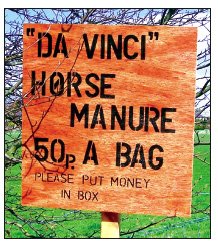
This is in the current edition of the London-published satirical magazine Private Eye.

It's the "I-Spy" feature, where readers send in photos of strange things they have seen.

The magazine is published every fortnight, and the website changes, so I have kept the photo, and here it is, before they take it down. The photo was (the magazine states) taken opposite Rosslyn Chapel, Edinburgh.


And I hereby announce that, henceforth, this blog is a DaVC-free zone!

Tuesday, May 23, 2006

Surprised By Detroit!

Fancy going to Detroit for a holiday? No, stop, don't ring up the men in white coats yet!

Detroit has the Detroit Institute of Arts; OK, it's not big, but there is reasonable quality material there. The best known work there is probably the series of large murals by Diego Rivera based on the Ford River Rouge plant.

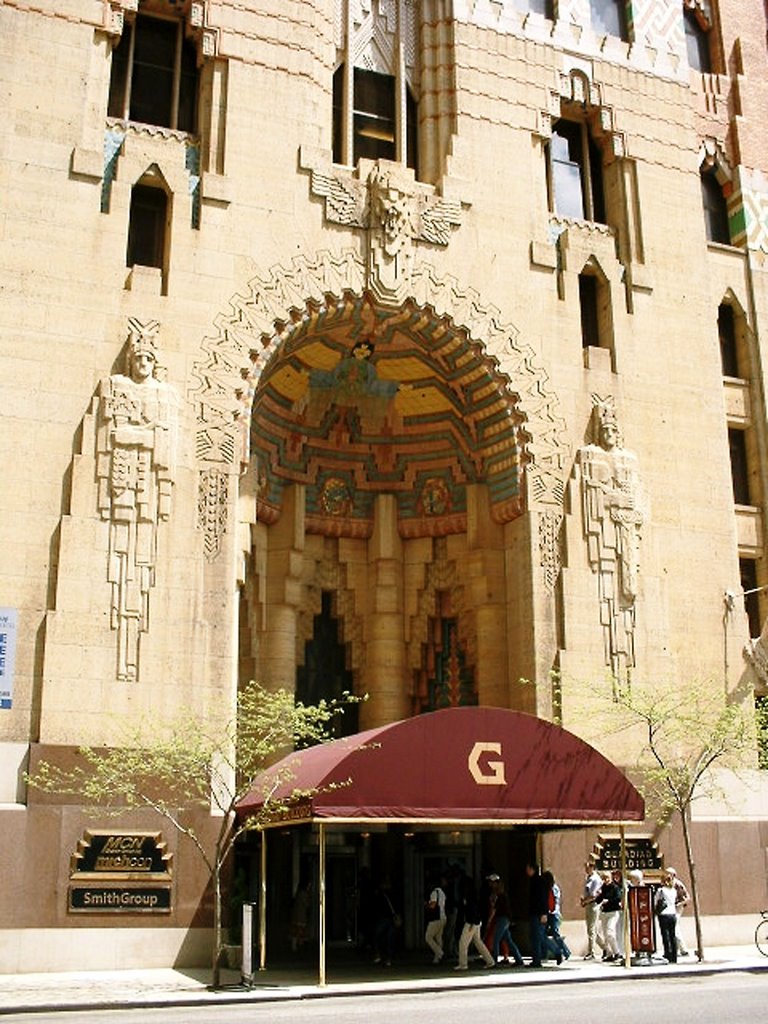
You could also spend a pleasant morning walking around downtown Detroit admiring the architecture, if you're interested in that sort of thing. The heyday of the city was the first few decades of the twentieth century, and one place definitely worth dropping into is the Guardian Building. Here is the art-deco style entrance:


But especially, you could spend two days at the Henry Ford in Dearborn in the western suburbs. You get SMART bus 200 from downtown to the Fairlane Mall, and then bus 250 to the Henry Ford. There is the Henry Ford Museum, Greenfield Village, and tours to the River Rouge plant. I suggest one day for the Museum and River Rouge, and one full day for Greenfield Village.

I spent one day there and I got to the Museum and the Village. But frankly you could spend a full, enjoyable day at the Village.

Henry Ford created Greenfield Village; he moved the homes of some famous people lock stock and barrel, piece by piece, and rebuilt, such as the homes of Harvey Firestone, the Wright Brothers, Robert Frost, and the house where he himself was born. And other buildings which interested him. He also moved and re-built Thomas Edison's New Jersey laboratory.

So don't write off Detroit for your trip across America. And, by the way, I am not being sponsored by the Tourist Board to write this!!

Vermont

I realise now that it was probably Bob Newhart's sitcom series (where he ran an Inn) that planted the seed inside me to visit Vermont. For years, I have been meeting Vermonters at the Holiday Fair in Dublin each January, and saying: "One day!"

Last month I made it. I got a bus from Boston to Burlington, then a taxi to the airport, where I picked up a rental car (they gave me a Toyota Corolla). This was the first time I had ever driven on "the wrong side of the road". It took me about twenty minutes to get used to it; I was slightly more distracted by trying to navigate my way out of Burlington, as there were plenty of road works.

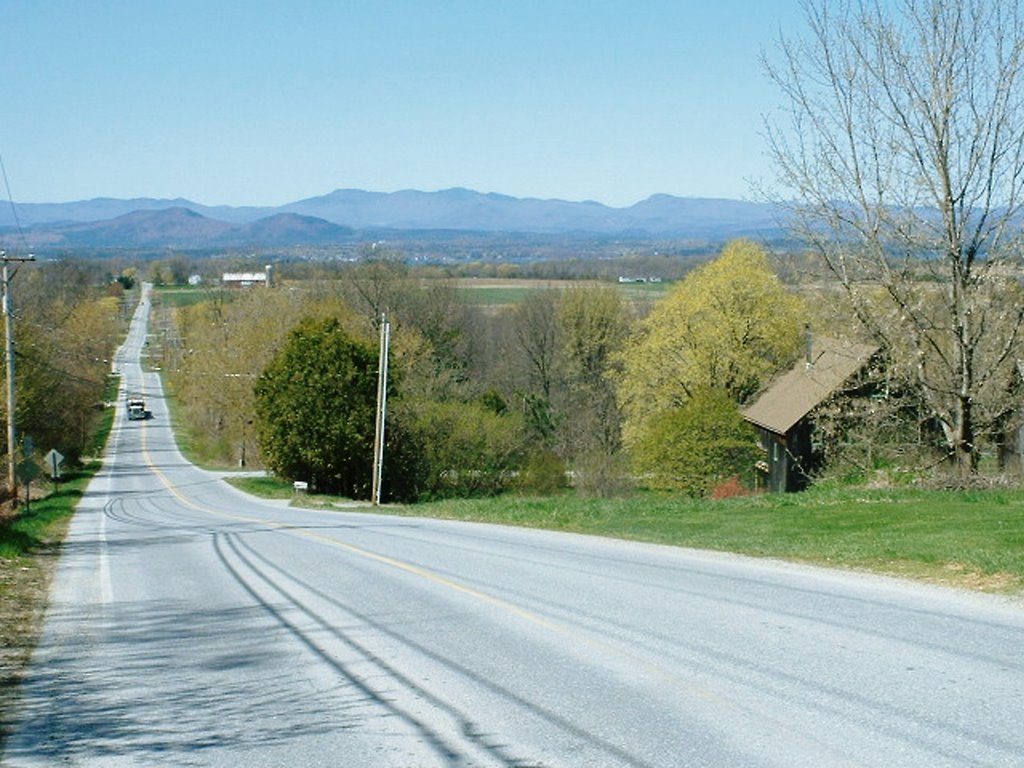
Frankly, I still have reason to go there, because I didn't go to Stowe and the mountains region. I drove that day just to get the ferry across Lake Champlain to Essex. And on that road to the ferry, I drove over a hump in the road, and saw a view of the Adirondacks which reminded me of what Hilaire Belloc wrote in The Path To Rome when he described seeing the Alps. Here is a photo, actually taken when I travelled in the opposite direction.


On another day, I drove north and crossed the bridge near Rouses Point into Vermont, intending to visit St Anne's Shrine. I discovered when I got there that it was closed. Tough luck. But that area is very nice, and reminded me of Ireland, with the green fields and farms.

Friday, April 28, 2006

As the sun sets over a glorious scenic view. . .

. . .let me apologise for not posting something sooner.

Right now, I am in Lake Placid, in upstate New York in the Adirondack Mountains. The sun is just beginning to set, as I sit here, look out the window, and see the glorious view of Mirror Lake with the mountains as a wonderful backdrop.

I'll post pix of my trip later.


N.B: Please remember in your prayers: a friend of mine is undergoing major surgery on May 5th.

Tuesday, April 04, 2006

On St Louis-Marie de Montfort

Yes, I know his feast day is not until April 28th, but I thought I should put this up now anyway.

When I went on my own Tour de France in 2002, one place I visited was St Laurent-sur-Sevres.

This is the village in the Vendee region where the saint is buried; it is a minor basilica, and was also visited by Pope John Paul II, who, as we all know, was a devotee of De Montfort and his True Devotion.

There is, as far as I am aware, no bus service to the village, so you can take the train to Cholet, a good-sized town seven miles to the north, and get a taxi from there. I believe there is one hotel in St Laurent, though it was full when I got to the area, so I stayed Saturday night in Cholet, and got a taxi to St Laurent for 1030 Mass.

At the time, I was using just a simple, cheap single-use disposable camera, so the photos are not good. Apologies!

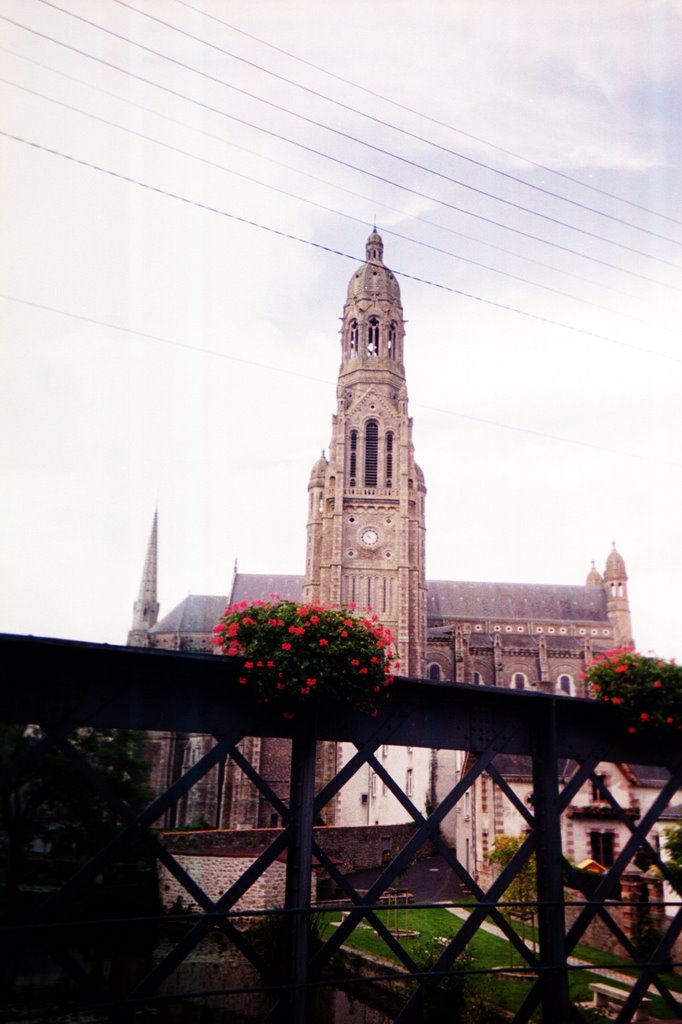
Here is the basilica from the bridge:


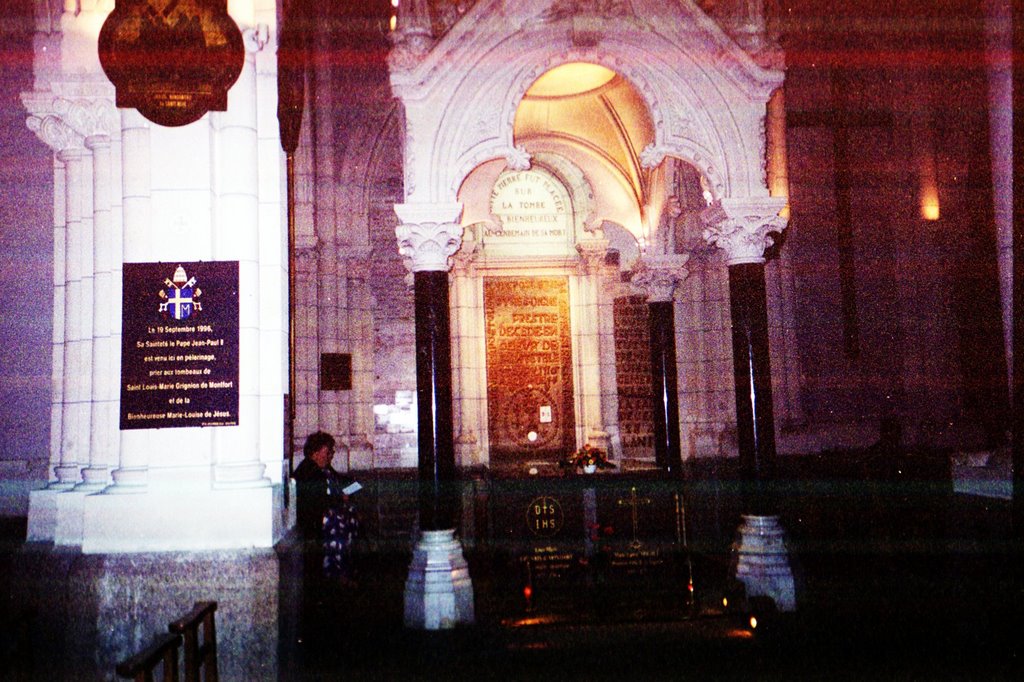
Here is the tomb of the saint:


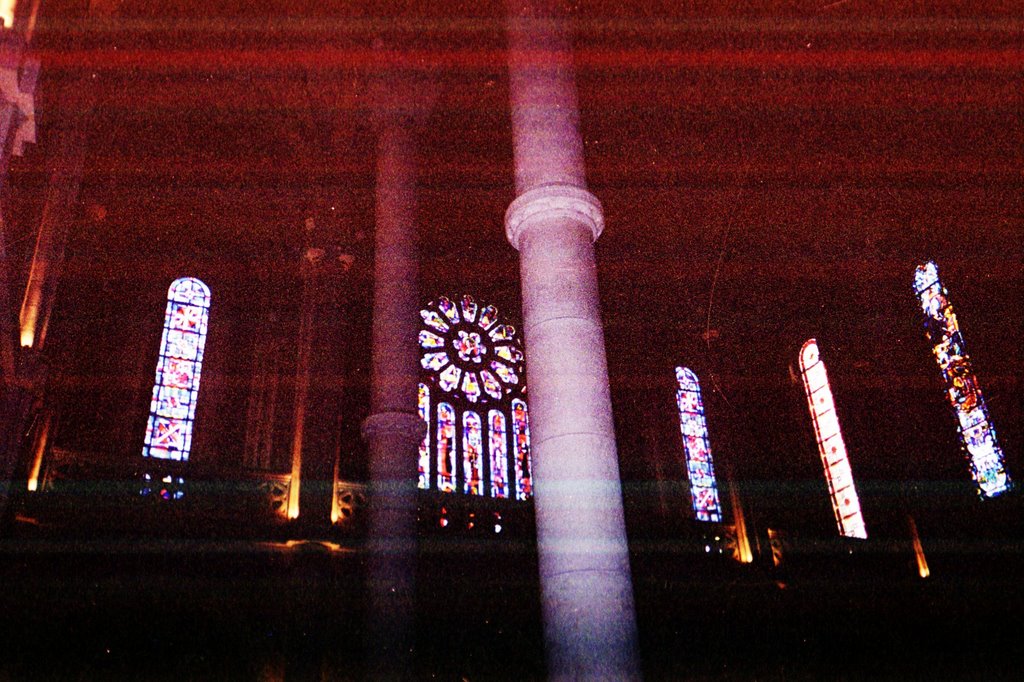
And here is the stained glass window over the main entrance. Each of the five vertical parts of the window represents the various religious orders and lay movements which the saint either founded or inspired:

I admire this man. . .

. . .who features in this news story which happened today.

Even though his girlfriend became blind and brain damaged in an accident, he stood by her and married her last year.

I have no connection with anybody involved, and I have no knowledge of the accident, and I assume that there was no guarantee, when they got married, that the court proceedings would conclude in their favour.

But I can think of some men who, faced with this situation, would have dumped the girlfriend.

Two phrases come to my mind: the first is that love is not an emotion, but an act.

And the second: "My yoke is easy and my burden light". You might think it is going to be a heavy cross for him to bear looking after his wife, but I have a feeling that, sometimes, what seems to us to be a cross, to someone else could be regarded as a blessing.

Friday, March 24, 2006

Feeling better

Well, I feel much better, but whatever infection I got in the first place hasn't totally gone away.

Originally, I was prescribed antibiotics for only seven days; I am assuming that the doctor who treated me in A+E was of the opinion that I would get to see a specialist within seven days.

I heard nothing from the hospital, so on Thursday morning of Cheltenham week, I decided to go to the hospital to find the ear specialists' department and make some enquiries.

I found the Appointments office, and the lady there told me that the doctor had written a letter to that department explaining my situation, and that my case has been assigned to a specialist. She added that the specialist basically reads through all the cases he gets, and then decides on which ones are the more urgent. Then people are called to see him accordingly.

She added that I wouldn't hear anything for a week at least. She was right. I've heard nothing - apart from the €60 bill for my trip to A+E, which arrived the Thursday morning after my Sunday night visit there.

So the antibiotics came to an end after seven days, and I was slightly worried that the pain might return. The last tablet was taken Monday morning last and then I went back to work; but although there was a slightly different feeling in my ears Monday evening, I have experienced no pain at all since then.

Right now, there is a high-pitched tone around my ears, but it is at a very low volume. Generally, I hear everything at a lower volume than before, and in work I find myself asking people to repeat themselves and then I move closer to them.

Thus two weeks after getting the first feelings, symptoms and pain, I still do not know what exactly I got; I suspect it is a perforated eardrum, but I don't know for certain. I won't know until I see the specialist, but at the moment, God only knows when that will be.

Tuesday, March 14, 2006

Question: What can possibly spoil my enjoyment of watching the Cheltenham Festival this week on TV?

Answer: a perforated eardrum.


OK it doesn't spoil it too much, but I have to be a bit careful with how I set the volume control.

Right now, my ears are surrounded with a strange humming sound, similar to the sound made by your kitchen fridge when you plug it in. Occasionally, this humming is joined by whistling and/or bell ringing, all to the rhythm of my pulse rate.

I first felt all this Friday evening, and after two sleepless nights, I decided Sunday afternoon to head to the nearest hospital Accident and Emergency Dept to get either a complete cure or at least something to make me sleep at night. Anyway, I knew I wasn't going to be back at work Monday.

This was the first time in my life I had presented myself at an A+E hoping for treatment; I was also perfectly aware that my case was not necessarily an "emergency", because I knew that I was not likely to drop dead within half an hour.

I got there about 4.30 pm, registered at A+E Reception, and then about fifteen minutes later I was called into what they call an Assessment room. I told my story to a gentleman in a green surgical gown who told me that there were several people ahead of me, and it would be several hours before I would be treated.

So I went back home, had some dinner, and went back to the hospital to wait through the pain; I got back there about 7.30 pm, and I was called to see a doctor at 0140 am.

Now I have been prescribed anti-biotics, so I no longer suffer pain and at least I can sleep a bit at night. I will take this week off work, and I am awaiting the setting-up of an appointment with an ear specialist, but God only knows when that will be.

A lot of people in Ireland complain about what is known as the "two-tiered health system"; i.e., one category of health service for those who can afford it, and one for the normal punters, such as what I went through Sunday evening.

But I have come to the conclusion that in Ireland, the main reason why we have a two-tiered health system is because there are quite a number of people who want it that way. And if the two tiers here were brought much closer together, I predict that a certain class of people will go abroad in order to be treated as the superior class of person they think they are.

Sorry if I sound like I am waving a red flag.

Wednesday, March 01, 2006

A Monk's Life

I've just finished reading "The Monk Cardinal" by Anthony Howard, a biography of Cardinal Basil Hume, Archbishop of Westminster from 1976 until his death in June 1999.

Here is one of the highlights; it describes his domestic arrangements soon after moving in at Westminster:

"Yet, from the start at Westminster, there was perhaps a hint of strain in Basil's custom of having two boiled eggs and a choc ice before going straight up to his "cell" (bedroom) as soon after 10.30pm as could be managed. (There was only one exception to this rule: in the winter when Match of the Day was on BBC1 on Saturday nights, Basil postponed his bedtime and insisted on watching right through to the end.)"

New Bishop of Ferns appointed

A new Bishop of Ferns has been appointed, Monsignor Denis Brennan. The official press releases are here.

What seems to me to be the most interesting part is this paragraph from the state ment of Archbishop Diarmuid Martin of Dublin:

"Archbishop Martin takes the occasion also to restate his appreciation of the
extraordinary contribution Bishop Walsh has made during his time as Apostolic
Administrator of Ferns, while not in any way neglecting his intense ministry
as Auxiliary Bishop in Dublin. The Archbishop feels certain the Archdiocese
of Dublin will benefit enormously from the experience and expertise which
Bishop Walsh acquired during his ministry in Ferns."


Two thoughts: firstly, this marks a significant step in moving on after the publication of the Ferns Report; the impression I got was that everybody in Wexford likes Bishop Walsh, yes, but everybody also felt that he was there temporarily to clean up the mess left by the two previous bishops. The RTE news item today emphasised that Monsignor Brennan is the first "local man" in a generation to become Bishop of Ferns.

Secondly, this means we can all resume a favourite sport of many, which is speculating about reshuffling bishops. There was a front-page story in last week's Irish Independent with rumours that Diarmuid Martin will shortly be off to a job in Rome, which may be the reason why he didn't get a red hat last week; and also that Bishop Eamonn Walsh will (or might) be the next Archbishop of Dublin.

I have met Bishop Walsh a few times and he is, honestly, a very nice and holy man. Suffice to say that if Diarmuid Martin does go back to the Vatican, then Eamonn Walsh will be the bookies' favourite to move into the big house in Drumcondra.

More bad news for the Welsh!

I've just gone to Catholic Ireland and looked at the Liturgical Notes in the top right hand corner; because it's Ash Wednesday, "St David is not celebrated this year". Poor Wales! And this after getting beaten at Lansdowne Road last Saturday.

Come to think of it, I have never been in Wales on St David's Day; nor have I ever been to the city of St David's - at least not yet!

But in March 2000, when Ash Wednesday occurred in the week before the Cheltenham Festival, I went over early on Ash Wednesday morning on the boat to Holyhead, and journeyed by bus to Aberystwyth. I really wanted to have a look at the National Library of Wales.

That evening I went to Mass here and there was a good crowd; Aberystwyth is a university town, and I guess the average age was about 20 or 21 - and I heard a lot of Irish accents.

I haven't been back there since. One day. . .

Wednesday, February 22, 2006

Everybody needs prayers

This story is from the excellent Catholic Ireland website.

An armed robber on a bus in Brazil, asked an Irish priest to pray for him after he discovered that he was a priest.

Please Officer; Can I Go Back To Jail?

There was a reference to this story in today's Racing Post and it literally made me laugh out loud.

A RECENTLY-RELEASED prisoner carried out a robbery at a betting shop because he wanted to return to jail, a court was told.


And yes, it did make me feel a bit sorry for him.

Friday, February 03, 2006

Memo to readers on the Western side of the Atlantic

Last September, I went to Italy, San Marino and Vatican City for my holidays (See Archive September 2005 on the left bar). This year I will go to America and Canada, and it will be after Easter.

I will be visiting New York, Boston, Chicago, St Louis, Detroit, Montreal and Toronto, though not necessarily in that order.

If anybody has any ideas for places to see, or tips on where to get Mass, or anything exciting, or places to avoid, the Comments box is below.

Friday, January 27, 2006

I've said it before, and I'll say it again!

If anybody ever denies the existence of God, tell them to listen to Mozart.

If anybody ever tells you that human beings are simply the product of a random evolutionary process over millions of years, tell them to listen to Mozart.


A very happy birthday: Wolfgang Chrysostomos Johannes Theophilus Mozart! May you take your rightful place composing for and conducting the Heavenly Choirs!

Wednesday, January 25, 2006

As soon as I read this. . .

. . .I knew I simply had to write it down and preserve it forever. Now I am putting it up online.

About a week ago I was reading a book from the library called "Turn Left At Greenland" by Mark Little, who was RTE's Washington Correspondent from September 1995 to January 2001. Obviously, Bill Clinton features prominently.

In an early chapter, Little writes about Clinton's home town of Hot Springs, Arkansas; and he tells this story about the future President and his mother, Virginia:

During the 1992 campaign, a good friend of mine interviewed Virginia. While the cameras were on, she gave the approved text of the Clinton biography but when the cameras were turned off, she kept talking. One day, she told my friend, she was baking cookies while young Billy worked on his homework at the kitchen table. She put the cookies out to cool on a baking tray and then left the house on an errand. When she came back, Billy had finished his homework and the cookies were gone. She turned angrily to her young son and asked what had happened. "What cookies? You never baked any cookies", he replied. Billy kept talking until he had persuaded his mother that she had not baked that night. "That's when I knew he would be a politician", Virginia said.

Tuesday, January 17, 2006

Delving into the past

I've just finished reading A History of the Irish Church 400-700AD written by Fr. John R Walsh and Thomas Bradley; the former is a priest of the Diocese of Derry, and a former teacher in St Columb's College, one of the most renowned secondary schools in the region; the latter-named is one of his past pupils, and is now a history teacher in the same establishment.

It's relatively short at only 192 pages, and I can recommend it for those interested not only in early Irish Christianity, but early British Christianity as well.

One part I found particularly interesting was what they had to say about St Brendan; his father's name was Findlug, and his mother was named Cara. He worked in Wales and Scotland, and the authors credit him with establishing churches in Perthshire and the Isle of Tiree. Let me quote from the book:

His place in history is secured because a medieval document, the Navigatio (The Voyage), bears his name. Some people hold that this odyssey is based on an actual voyage which Brendan made to North America. The Voyage was a most influential work in medieval times. Its text survives in some one hundred and twenty manuscrpts, some of them in Latin and the others in early forms of modern continental languages. The earliest surviving manuscript dates from the late tenth century. The Voyage is usually, and probably correctly, ascribed to a late ninth-century Irish peregrinus ("pilgrim" or "missionary exile") working in the Netherlands or Germany. A fascinating conglomeration of fact, fantasy and plagiarism, its popularity on the Continent in the Middle Ages led to a cult of Saint Brendan there and means that the name of a comparatively obscure sixth-century Irish monk survives in the name of a thriving city in Germany, Brandenburg.


So next time you hear one of Bach's Brandenburg Concertos, think of an Irish monk braving the elements of the Scottish climate to bring the faith to the Picts.

So the evidence points to the fact that it was not St Brendan who made that legendary trip across the Atlantic - if anybody did! But I can't help feeling that if the story was so relatively widespread across Europe, surely it must have had an influence on others and inspired them to seek to explore new worlds.

Another section deals with St Canice of Aghaboe, who is remembered as the patron of the city of Kilkenny, which bears his name, and is home of St Canice's Cathedral (Anglican). The authors tell us that he worked for a while in Scotland with St Colmcille (of Iona fame), and state: "He is remembered in Scotland to this day as Saint Kenneth and is credited with founding churches on the islands of Coll, Tiree, Mull and South Uist."

Which means that if you have a friend named Kenneth, then his name is not really Kenneth - it's Canice.

So allow me to pay tribute to the distinguished football player, Canice Dalglish; the late actor, Canice More; and the tenor Voice of Scotland, Canice McKellar; does that sound all right?